|
Kheer Bawani,
the most revered shrine of Kashmiri Brahmans
Khir Bhawani Temple is situated at Tullamula in the Srinagar
district, it is an important Hindu Shrine. The temple is
associated with the hindu godess, Ragnya Devi. An Annual
festival is held here on Jesht Ashtami ( May-June) when
Hindus visit the place in large numbers to offer prayers to
seek the blessings of the diety. Devotees also throng on
every Shukla Paksh Ashtami round the year & perform HAWANS
to please the Mother. The Historic Temple of Kheer Bhiwani
was built by Maharaja Pratap Singh in 1912 & later renovated
by Maharaja Hari Singh.
A view of Kheer Bhawani Temple.
Kheer Bhawani: The Goddess Ragnya Devi is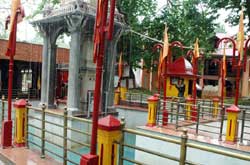 symbolised as a sacred spring at Tula Mula village, near (27
kms) Srinagar, Kashmir. The spring of Kheer Bhawani is quite
large and has always been held in veneration by the Brahman
population of Srinagar.
symbolised as a sacred spring at Tula Mula village, near (27
kms) Srinagar, Kashmir. The spring of Kheer Bhawani is quite
large and has always been held in veneration by the Brahman
population of Srinagar.
Within the spring is a marble temple. The temple-spring
complex is affectionately known as Kheer Bhawani as
thousands of devotees offer milk and 'kheer' to the sacred
spring.
The temple spring complex is affectionately known as Kheer
Bhawani because of the thousands of devottees who have
offered milk and 'Kheer' to the sacred spring, which
magically changes colour, turning black which warns of
disaster.
The temple of Kheer Bhawani is situated at a distance of 14
miles east of Srinagar against the background of natural
sight near the village of Tula Mula. This temple, is located
in the middle of a spring, around which there is a vast area
whose floor has been covered with smooth and beautiful
stones. In it exist large and old chinar trees beneath which
the pilgrims sit or sleep on mats of grass. The colour of
the spring goes on changing. While most of the colours do
not have any particular significance, the colour black is
taken as an indication for inauspicious times for Kashmir.
The legend associated with the temple goes that Lord Rama
worshipped Ragnya Devi during his exile. After the exile
period got over, Rama asked Lord Hanuman to shift the seat
of the goddess. The seat of the goddess was brought by Lord
Hanuman first to Shadipora and later shifted to the site
where the temple now stands. It is believed that it was the
wish of Mother Ragnya that her seat be place at Khir Bhavani
Mandir in Kashmir, India. And this wish was conveyed in
dream to a pandit, Rugnath Gadroo. The temple of Ragnya Devi
is called "Kheer Bhawani" because numerous devotees offer
milk and kheer (Indian sweet dish) to the sacred spring. It
is believed that milk and kheer turn to black color to warn
of any impending disaster.
Maharaja Pratap Singh got the temple constructed in 1912.
Later, Maharaja Hari Singh undertook the repair and
restoration work on the temple. The eighth day of the full
moon in May holds great significance for the devotees of
Ragnya Devi. They fast on this particular day and gather at
the temple in huge numbers. It is believed that on this day,
the goddess changes the color of the spring's waters.
The Kheer
Bhavani temple serves as the venue for an annual festival
held in May-June, on the occasion of Jesht Ashtami. During
this festival, a large number of Hindus visit the temple to
seek blessings of the goddess. Another occasion on which the
Kheer Bhavani temple gains special importance is Shukla
Paksh Ashtami. On this day, havans/yagnas are performed to
please the goddess.
|




 1
1 2
2 3
3 4
4 5
5 6
6 7
7 8
8 9
9 10
10 11
11 12
12